Container transport
The box is only half the job. The empty is the other half.
Plan drayage around terminal windows, chassis and empty positioning, and see what each move costs before you commit a truck.
A container move is a road trip with extra rules: a release that has to be valid, a window at the terminal, a chassis that has to be under it, and an empty that has to go somewhere afterwards. Orin plans the whole of that as one job rather than three.
- 1
Release
The booking, the line, the size and type, and the window you have.
- 2
The move
Planned with the chassis under it and the terminal window respected.
- 3
The empty
Back to a depot, straight onto the next job, or offered to another carrier.
- 4
The cost
Including the empty leg, on the shipment that caused it.
The empty leg is a cost, so it is planned like one
An empty run is the part of drayage nobody invoices and everybody pays for. Orin treats it as a leg with a cost and a position, which is what lets the planner and the optimizer do anything about it.
- An empty leg is a real leg on the trip, with its own kilometres, hours and toll, so the cost of repositioning lands on the shipment that created it instead of disappearing into an average.
- The optimizer sees empties as work to be avoided: a box that has to go back is a constraint it plans around, not a movement it adds afterwards.
- A depot is a location with opening hours like any other, so a return that cannot be made before closing is a conflict at planning time rather than a phone call at six.
An exchange for the empties you cannot place yourself
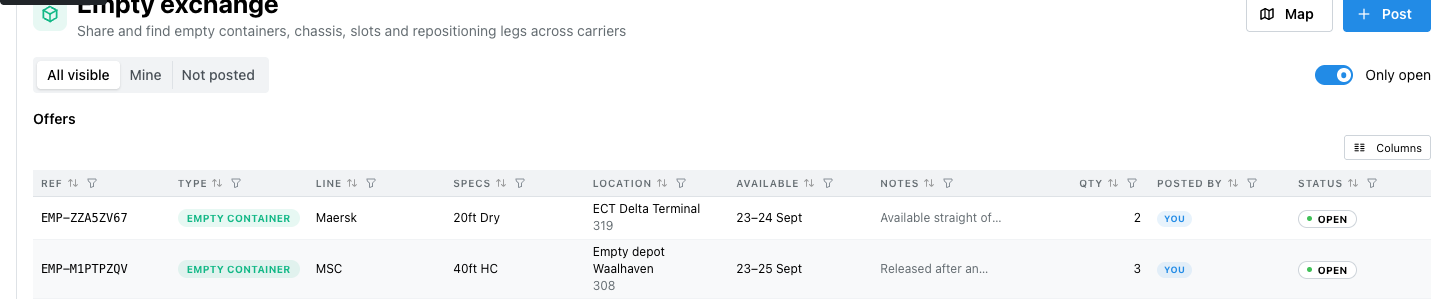
Every drayage operator has boxes standing in the wrong place and boxes needed in another. The exchange is where those two facts meet, across carriers, without either side publishing its customer list.
- Post what you have free and what you need: empty containers, chassis, free chassis slots and repositioning legs that are running anyway.
- Each posting carries the line, the size and type, the location, the window and the quantity. Location is approximate until a deal is agreed, so posting costs you nothing in commercial information.
- Visibility is yours: private, a chosen list of partners, or the whole network. A posting can be different for different partners.
- An accepted deal becomes an ordinary shipment with an ordinary settlement line, so it lands in the same margin and the same invoice run as everything else.
Terminals, and the windows they give you
A drayage plan that ignores the terminal is a plan that queues. Orin holds the terminal as a real place with real constraints, and can talk to the port systems that hand out the slots.
- Terminals, depots, rail yards and inland hubs are location types of their own, with opening hours, UN/LOCODE and their own driver instructions.
- Port community integrations for container release status and terminal slot booking: Portbase (NL), NxtPort Certified Pick-up (BE) and DAKOSY (DE). Enabled per account.
- A slot is a time window on the stop, so the planner sees it in the same place as every other window and the optimizer plans inside it.
What the customer sees
Container customers ask where the box is more often than anyone, because a box that is late costs them demurrage. Answering it is a link rather than a phone call.
- A tracking link per shipment, with the visibility level you choose, and no login.
- Regular customers get a portal: their own containers, documents, invoices and a place to order the next move.
See it on a container day.
Book a demoThirty minutes on our own demo account, with drayage moves, depots and an exchange board already in it.