Forwarding
You buy transport. The system should be built for that.
Book a departure, hand a leg to an agent, send a leg to a carrier with a price, and keep one record and one margin across all of it.
Most transport software assumes you own the truck. A forwarder's day is a sequence of purchases: a slot on a ferry, a leg to a subcontractor, a job to an agent at the other end. Orin models those as first-class work rather than as a fleet with the trucks missing.
- 1
Order in
By e-mail, EDI, API or the customer portal, read into one shipment record.
- 2
Buy the leg
Book a departure, send it to a carrier with a price, or hand it to an agent.
- 3
Follow it
Status and proof of delivery land on your shipment, whoever drove it.
- 4
Invoice it
Sell price against the three costs you bought, per leg and per office.
Scheduled services, and booking onto them
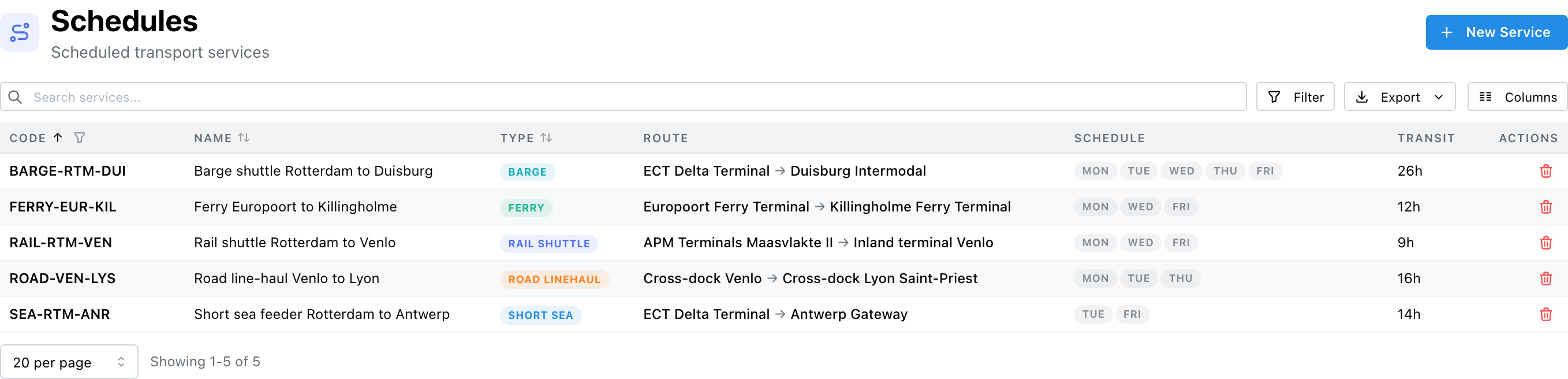
A ferry, a barge shuttle, a rail service and a line-haul run are the same shape: something that departs on a schedule, with capacity, a cut-off and a price. Orin holds them that way so booking onto one is two clicks rather than an e-mail.
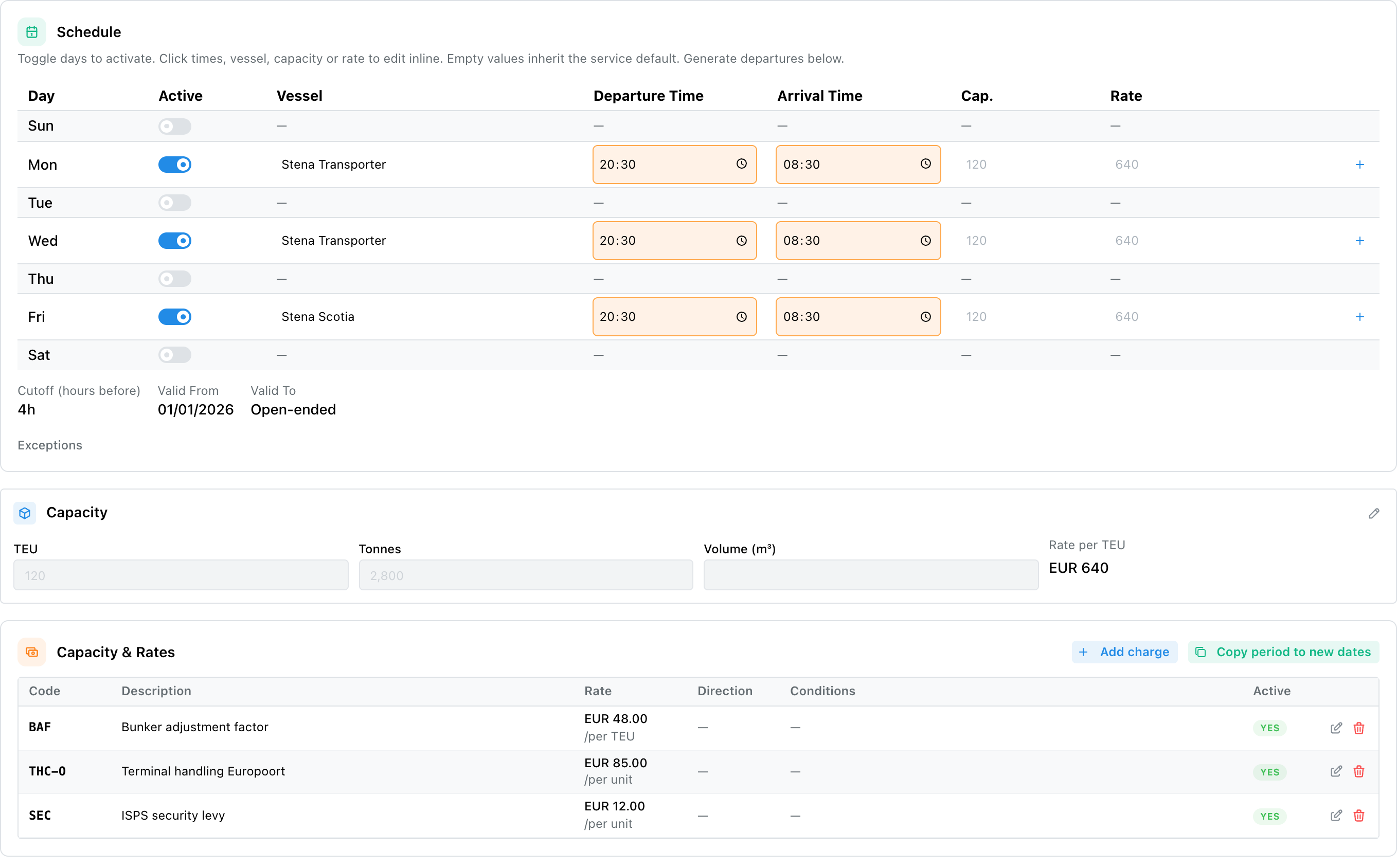
- Define a service once with its route, frequency, transit time, cut-off and capacity in TEU, tonnes, m³ or loading metres, then generate its departures for the weeks ahead.
- Ferry, short sea, barge, rail shuttle, air freighter and road line-haul are service types, so a mixed route is one trip and not four systems.
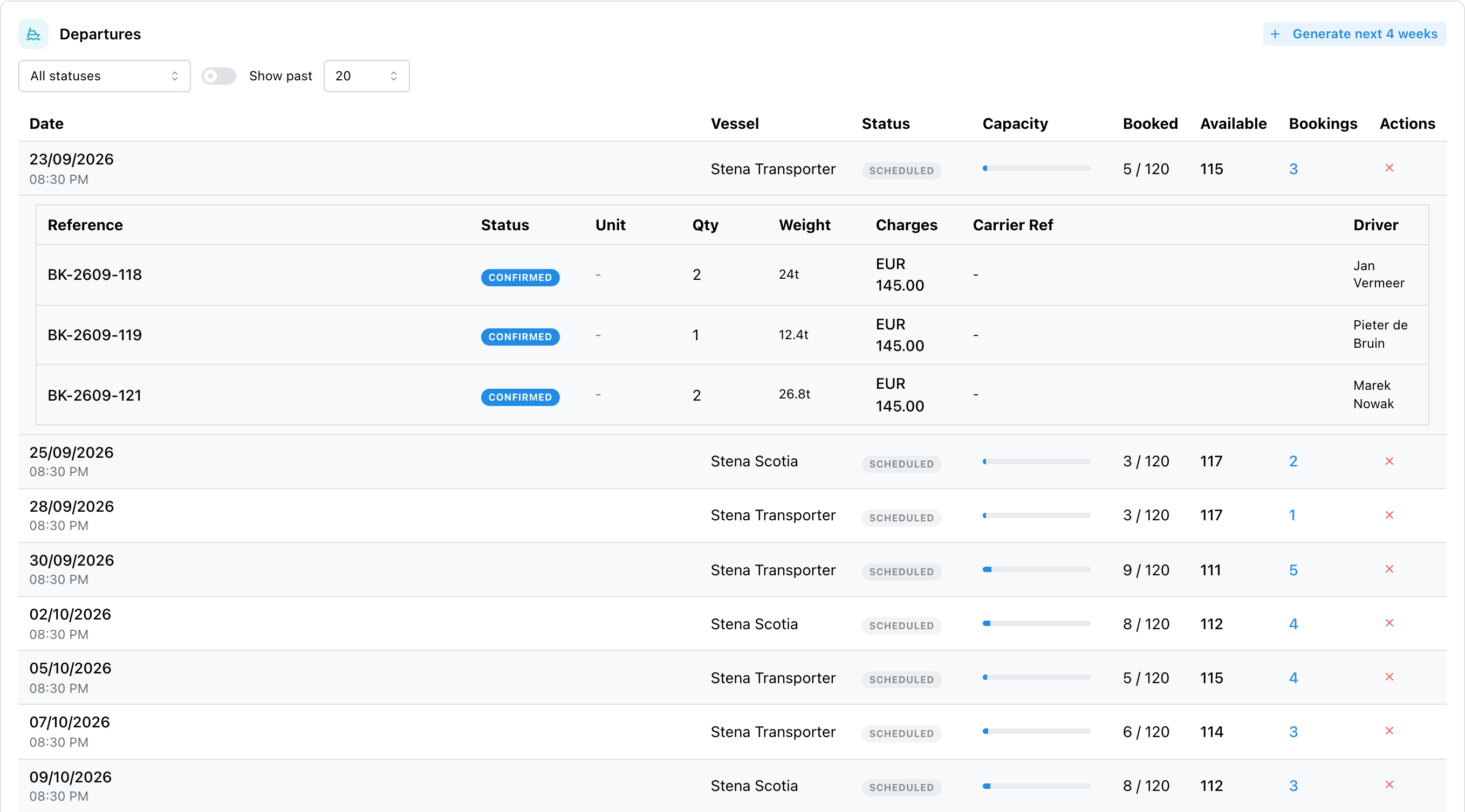
- Book a shipment onto a departure with a full lifecycle: requested, confirmed, rolled to the next sailing, cancelled or no-show, with the capacity on that departure kept honest.
- Per-departure rates and default charges, so the cost of the leg is on the trip before the carrier's invoice arrives.
Hand it over, and still know where it is
A leg you do not drive is still a leg you are responsible for. The difference between a forwarder who looks organised and one who does not is whether the hand-over loses the thread.
Three ways a leg leaves your hands
The difference is how much of your system the other side gets. All three end in the same place: status and proof back on your shipment.
Goes to
A carrier
- How it arrives
- An e-mail and a PDF with the price lines in them
- What they need
- They need no account
- What comes back
- The price you sent is already on the trip as the leg's cost
Goes to
An agent
- How it arrives
- One hand-over covering several jobs, as one batch
- What they need
- They need no login, only a share link
- What comes back
- They post status and proof of delivery through it
Goes to
A partner
- How it arrives
- Their own isolated workspace in the portal
- What they need
- They sign in
- What comes back
- They work their dispatches, and their prices and customers stay invisible to you
Whichever route it took, the customer-facing answer is the same one, because the status landed on the same shipment.
Multimodal is a route, not a project
Road to the quay, sea to the other port, road again to the door. One order, one customer price, three costs from three parties.
- Split a shipment across road, sea, rail, air and barge, each leg with its own carrier, its own cost and its own documents.
- Cross-dock and consolidation in the middle, with handling units scanned through the facility.
- Customs where the route needs it: export, import, transit, ENS and EXS, with per-lane document rules.
- Margin per leg and per department, with internal transfers, so each office's result is right even when they shared the job.
No fleet? Then you pay for no fleet
Orin is priced on active vehicles. A forwarder without trucks has none, so the base price is the price, and every carrier and agent you dispatch to costs nothing.
- Subcontractors, agents and carriers are unlimited and free.
- Users and drivers are included, so a growing office does not grow the invoice.
- If you also run a few of your own trucks, they are the only thing that counts.
What a bookable service looks like
A service is defined once and then it is a thing you book onto. Below: the same ferry as a schedule with rates, and as a forward order book.
See a forwarding day, end to end.
Book a demoThirty minutes on our own demo account: a booking onto a departure, a leg to a carrier, a hand-over to an agent, and the margin across all three.