Planning and route optimization
Plan your fleet around real costs and driving hours.
Orin builds a proposal for the whole fleet: every order on a truck, within capacity, time windows and the European driving and rest rules, costed with your own rates. The planner changes whatever they want to change.
Fleet-wide optimization is an Enterprise line. Standard includes route calculation: distance, drive time and tolls per trip.
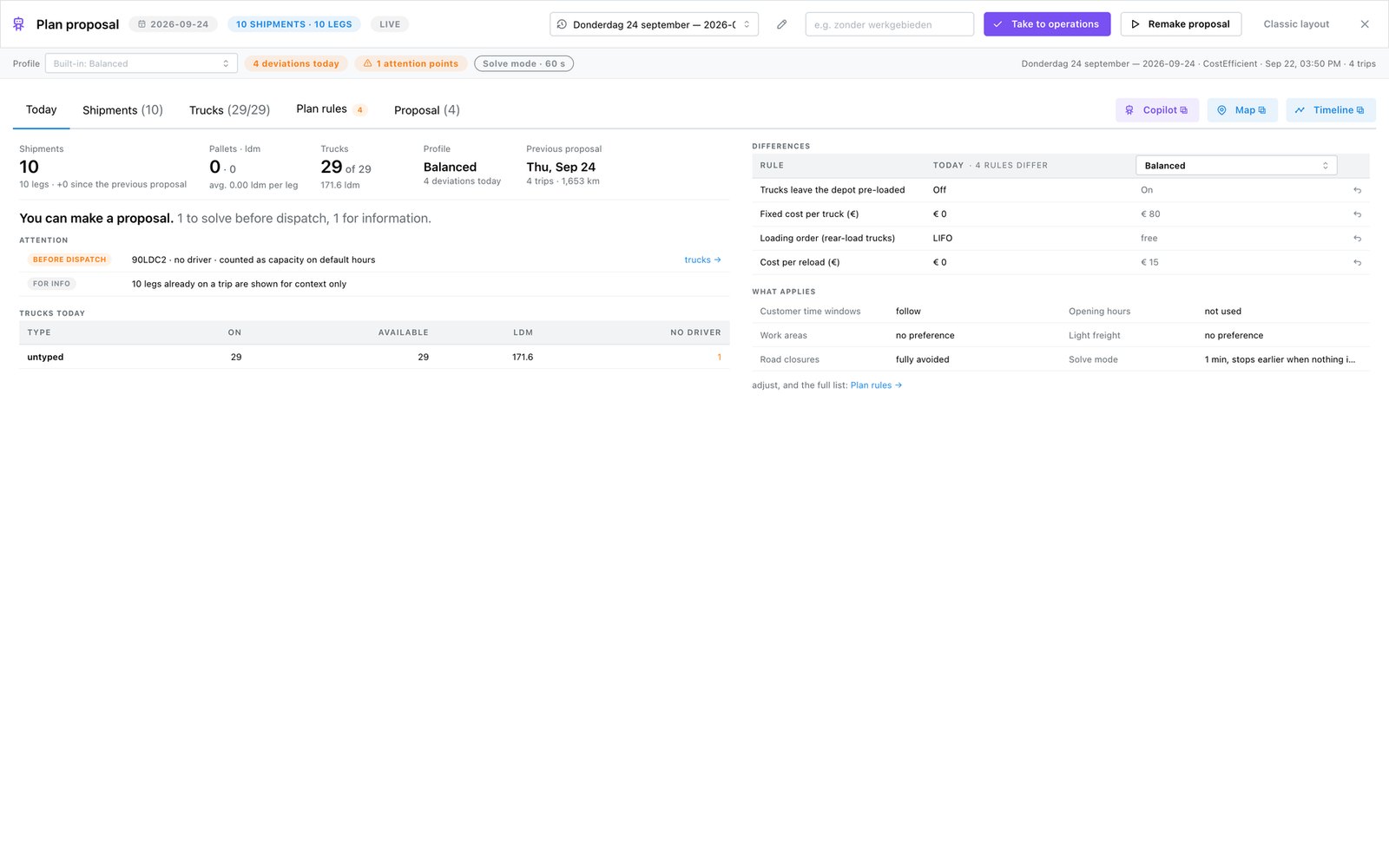
- Proposed trips
- One line per truck, in the order it drives them.
- Orders still to plan
- Whatever would not fit, with the reason.
- Estimated cost and margin
- Per trip and for the run, from your own rates.
The day in the clip: 25 trucks, 499 legs, every route along the road it was costed on. Those numbers describe this example day, not a saving.
Driving and rest times
The European rules (Regulation 561/2006) sit inside the model, not in a check afterwards.
Cost per vehicle
Your own rates per truck and per driver, not one average across the fleet.
Tractor + trailer
Available capacity follows the combination: the same tractor with another trailer is a different truck to the plan.
Every trip editable
The planner keeps the last word.
It optimises against cost, not distance
A 40-kilometre run with an expensive tractor and two hours of waiting can cost more than a 70-kilometre run with a van. A tool that only sees distance picks the first one. Orin costs the trip the way you pay for it.
The shorter route is not always the cheaper one
One delivery, tail lift needed, two ways to run it.
Nearest truck
- 42 km
- Tractor and trailer
- 2 h waiting at the dock
€ 186
Second truck
- 71 km
- Van with tail lift
- No wait
€ 124
Example figures. Orin picks on what running the job costs, not on the distance.
- Cost per vehicle and per driver. Fixed and variable cost per truck, plus the driver’s hours and allowances, so an old rigid and a new tractor do not count as the same hour.
- Toll per country over the actual route. German Maut and the Dutch Vrachtwagenheffing are measured on the road driven, not on an average per kilometre.
- The hand-over price is a lever. Running it yourself or giving it to a charter is weighed in the same sum, against the price you actually pay that charter.
- Nothing disappears quietly. An order that will not fit stays on the list with the reason it did not, so you can reprice it, move the window or give it to a charter.
Two objectives, and you pick one
Lowest cost, serve everything
Every order gets planned, and the run is built for the cheapest way to cover them all. What you want on a day the work has to go out.
Highest margin, surface the losers
Orders that cost more to run than they earn are left out and named, so you can reprice them or hand them on instead of quietly carrying them.
Driving hours are a hard constraint, not a warning afterwards
The regulation sits inside the model rather than in a check afterwards, so a proposed trip fits inside the daily driving time, the break and the rest that Orin models. What it can hold to depends on what it knows about the driver and the day.
So: a proposal fits the rules as modelled here. It is a planning aid, not a compliance record, and the driver's own tachograph stays the authority.
What it models, and what it needs
- Modelled: daily driving time, the 45-minute break (including mid-transit on a long leg), daily rest, shift start, and each driver's availability.
- Needed from you: who is working that day, when their shift starts, and which vehicles are out. Orin has no tachograph feed, so it plans from what is in the roster rather than from what a driver has already driven this week.
- Breaks land where they have to — including mid-transit on a long leg, not only neatly between two stops.
- Time windows per stop, including the difference between what the customer agreed and what your operation made of it.
- Learned stop times. How long unloading at that one distribution centre really takes, from your own history, instead of a flat fifteen minutes for everyone.
- Vehicle and driver availability. Inspections, charter periods and days off take a truck out of the plan without anyone having to remember.
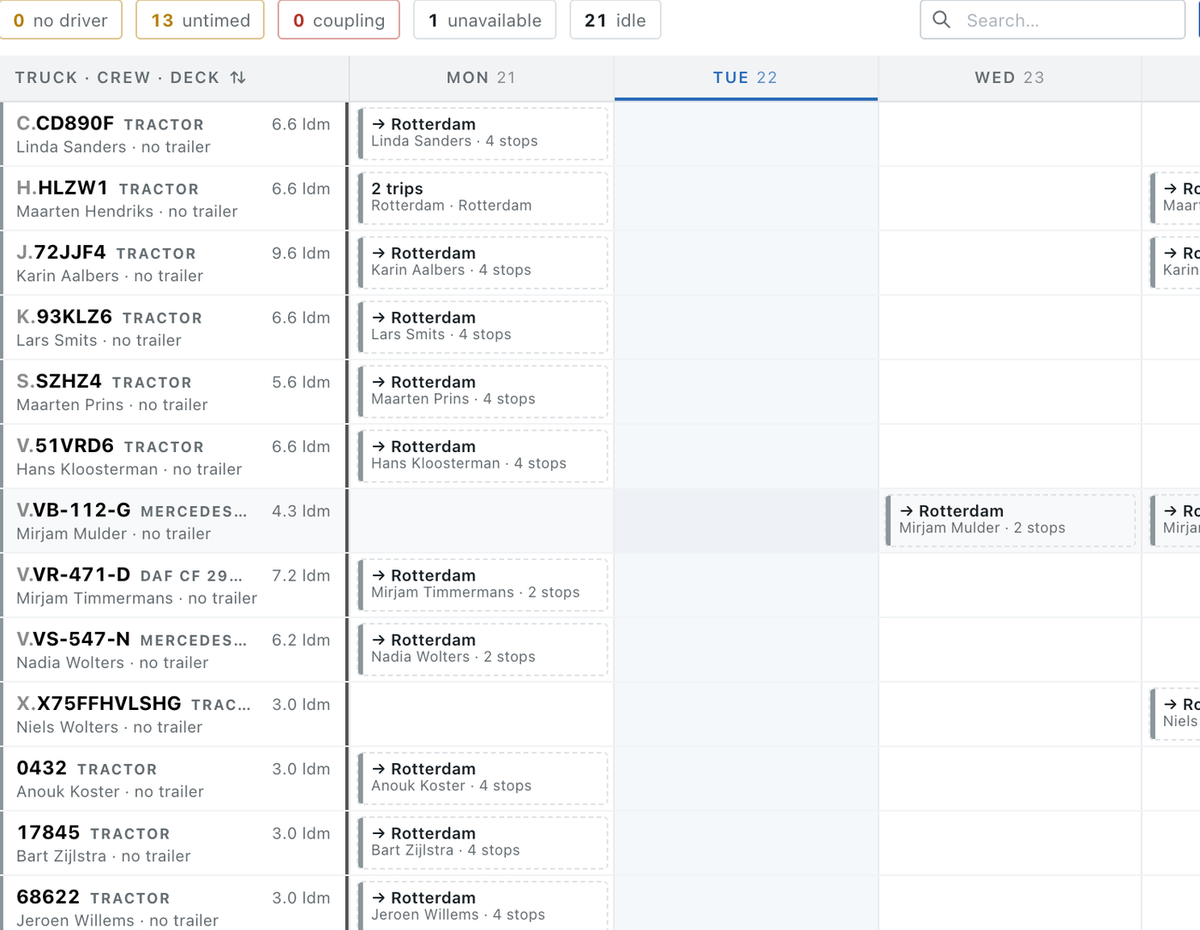
Capacity the way you actually have it
The same tractor with another trailer is a different truck to the plan: other loading metres, other weight, other cargo it may carry. Capacity follows the combination that is actually coupled that day.
See supported constraints
- Tractor and trailer add up into one combination, with the load space that combination really has.
- Width-aware loading metres. Two half-pallets side by side are one loading metre, not two.
- Rules per vehicle type. Only shipments under a certain size on the van, or a weight limit on the tail lift — recorded as a rule, not as an agreement in someone’s head.
- ADR follows from the cargo, so dangerous goods do not end up on a vehicle that may not carry them.
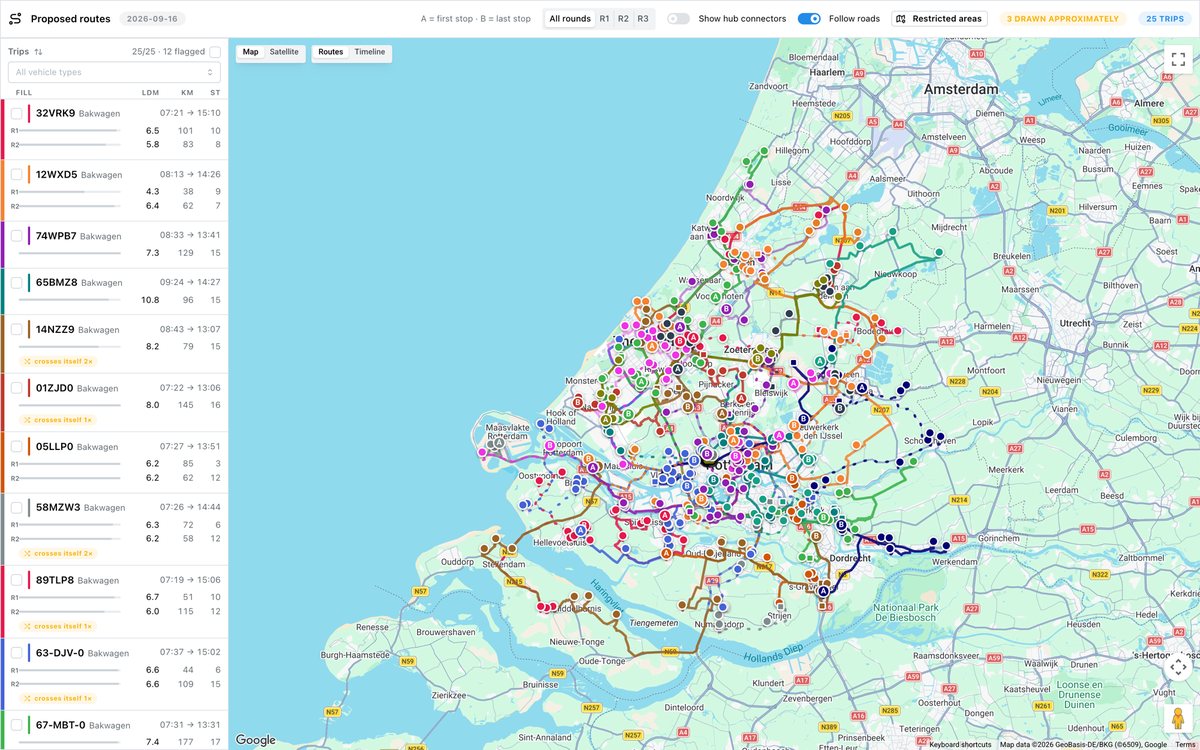
The road as it is today
What the planner notices is that the proposal avoids the section that is shut, keeps the van out of the zone it may not enter, and recalculates the moment something changes.
What the route accounts for
- Road closures from the national NDW feed, pulled every day rather than whenever somebody presses a button.
- Low-emission zones per city, matched to the vehicle’s emission class.
- Toll networks per country, so tolled kilometres are the tolled kilometres and not every kilometre in that country.
- No charge per lookup. A large board costs compute time, not a bill per route requested.
A proposal, not a verdict
The planner who has run that region for twenty years knows things no system holds. The goal is not to replace that knowledge, but to take the two hundred sums underneath it off their desk.
- Every proposed trip can be adjusted by hand, and the cost recalculates as you do it.
- Large days break apart into sub-plans per department or planning group, so a board of hundreds of trucks stays readable.
- A run works in the background. You keep going and look at it when it is done.
- Runs are kept, so you can re-read a proposal later and hold it against what was actually driven that day.
Where it earns its keep
Four operations where it pays back fastest.
- Distribution from one or more depots
- Many stops, tight windows, a mixed fleet. The case the optimizer was built for.
- Container drayage
- Terminal windows, chassis and empties. The gain is usually in the empty running.
- Forwarding with subcontractors
- The hand-over price competes with your own trucks in the same sum.
- Groupage and pallet networks
- Line-haul between hubs plus the last leg. Big days break into sub-plans per group.
What a run gives back
Not another map. The run page is the list you work from afterwards.
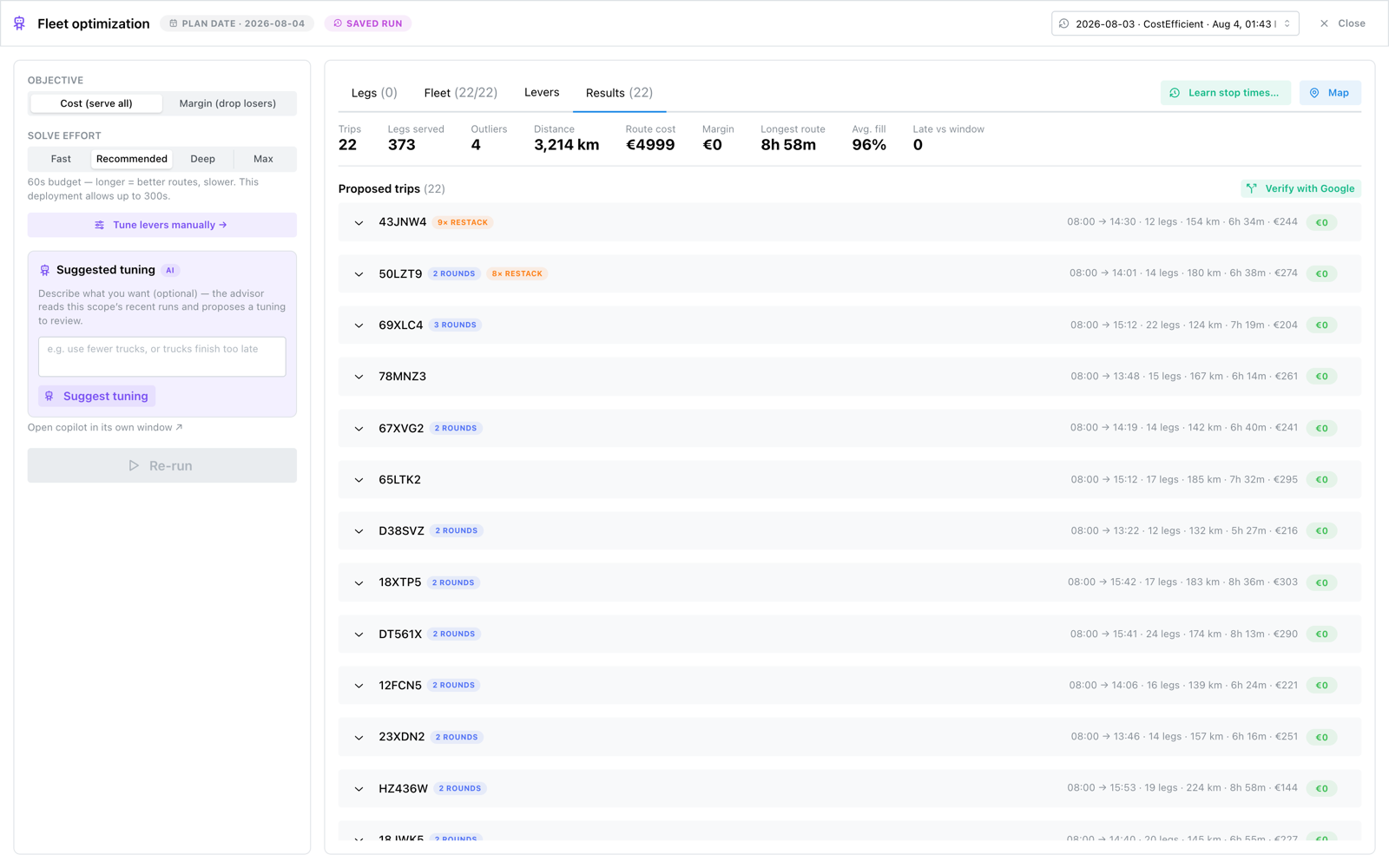
- The trips, per truck, with departure and return times.
- Kilometres, hours and cost, per trip and for the whole run.
- How full each truck ended up, so you see the slack you have left.
- Orders left unplanned, each with the reason it did not fit.
- Outliers flagged: the trips worth a second look before you dispatch.
- The run is kept, so you can hold the proposal against what was actually driven.
Frequently asked questions
Does this replace my planner?
No. It hands over a proposal your planner works on. In practice the work shifts: less time puzzling over which truck fits what, more time on the cases that genuinely need judgement.
Is route optimization included in the Standard plan?
No. Standard includes route calculation: automatic distance, drive time and tolls per trip, plus planning, dispatch and the driver app. Optimising the whole fleet against cost or margin is an Enterprise line. We would rather say that here than in a quote.
How long does a run take?
It depends on the size of your board: the number of stops and the number of available trucks set how big the puzzle is. A run works in the background under a hard time limit, so it never runs away with itself and you keep working meanwhile.
Does it work if I subcontract?
Yes. Charters take part in the same trade-off: the price you pay a charter is weighed against what it costs you to run it yourself, so the choice is a calculation rather than a feeling.
What if it proposes something I do not want?
Then you drag it. Every trip can be changed, and the moment you do, the cost and driving hours of that changed plan are recalculated, so you see what your adjustment costs or saves.
Why is there no savings percentage on this page?
Because we do not have one we can stand behind. A percentage is only meaningful against a baseline, and the baseline our customers actually have is a planner doing it by hand. We have not measured that, so quoting a number would be borrowing someone else's. What we will do is run it on your own vehicles, costs and driving hours next to the way you plan today, and you can read the difference yourself.
Do you do network design?
No. Network design, depot siting and territory redraws are a different kind of study and we do not sell one.

See it on a live system.
Book a demoThirty minutes on our own demo fleet, nothing needed from you. If you then want it next to the way you plan today, we set that up on your vehicles, costs and driving hours.